

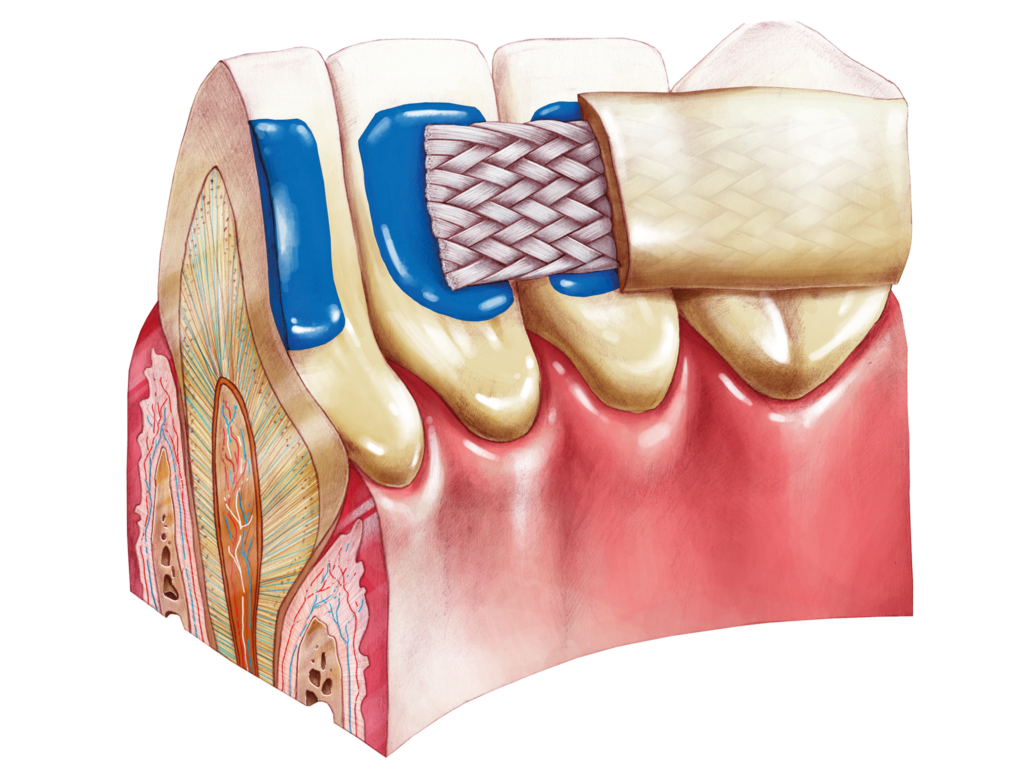

We increase the strength of large cavity fillings, especially in posterior teeth, unattainable with composite alone. The parts of the restorations that are most exposed to chewing forces, such as the lower lingual cusps of molars without additional support will fracture. We support either the most exposed cusps, incisal edges or entire chewing surfaces.
We carry out immediate restorations of lost teeth, from CHORDS, in one visit, often within 1-1.5h, a little longer than on a COMCORD framework, but much faster than on fibreglass. We combine CHORDS with your favourite composites (remember to put the composite under the fibre). These methods are particularly important when the patient, as a result of trauma, has lost an anterior tooth and cannot function properly without it. Fiber-supported composite restorations are the only permanent restorative method in one visit, especially since we can do it ourselves.
Thanks to non-invasive fibre composite restorations, we also restore missing teeth for patients who do not agree to implants, are afraid of surgery or injections or do not want to grind the adjacent teeth.
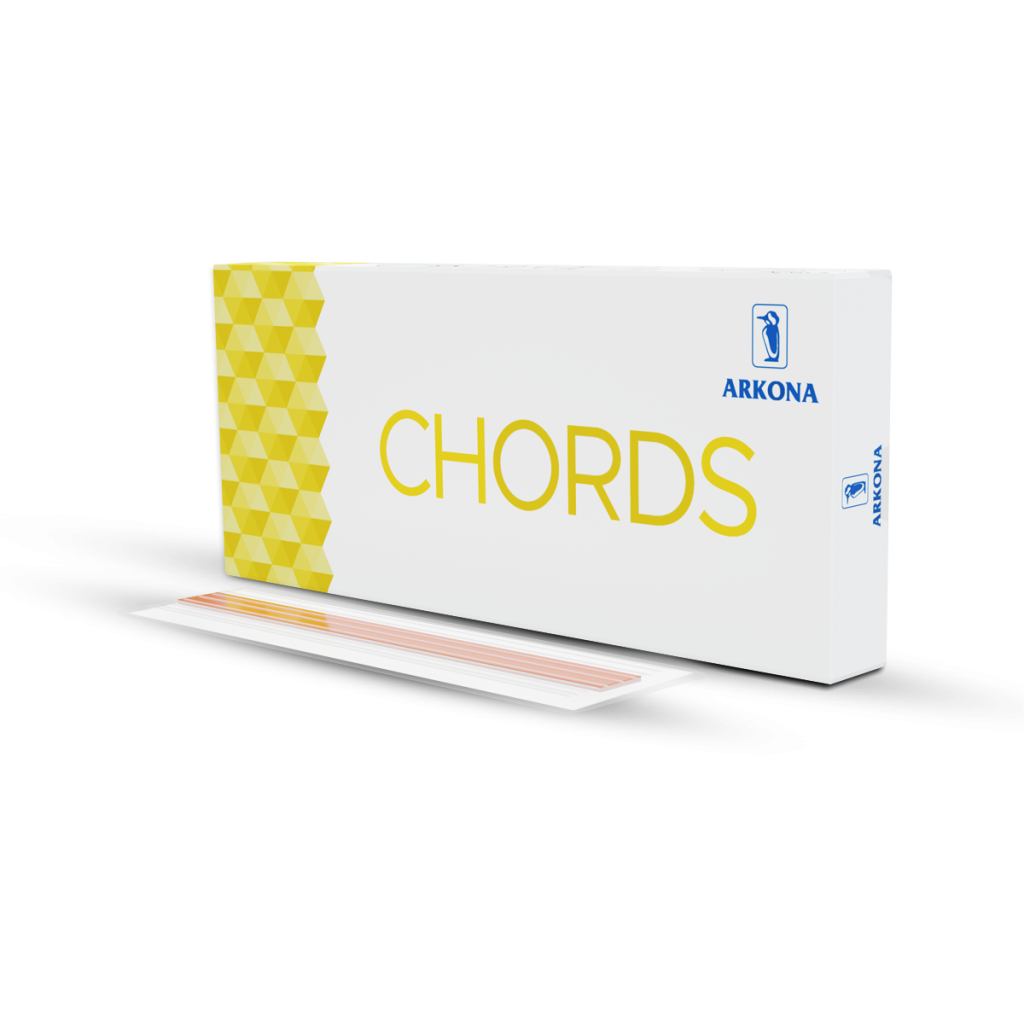
We provide support for fixed composite restorations such as inlays/onlays, crowns, endocrowns and bridges. We developed CHORDS according to the requirements and wishes of dentists in relation to fibres and to make their work easier, when there were only uncomfortable glass fibres available on the market that dentists did not like to work with. CHORDS is made of highly flexible and non-elastic polyaramid fibres, soaked in a mixture of light-curing resins.
We carry out complex work, especially in difficult occlusal conditions, and these are often temporary bridges with extended durability for healing after implant surgery.
We stabilise teeth loosened periodontally or due to traumatic reasons. Depending on your needs, these will be permanent or temporary splints. CHORDS combines with all modern composites, both flow and paste types.
We restore single missing teeth by splinting adjacent teeth. Many cases of periodontitis are accompanied by tooth loss. We then make a stabilising splint where, in place of the lost tooth, we attach the patient’s own tooth or a ready-made acrylic or composite crown, or model the missing tooth with composite. All methods are equivalent and all of them use a splint with CHORDS.
1 fiber length: 10 cm.
Available fiber widths: 2, 3 or 4 mm
Are CHORDS braided or parallel fibers?
CHORDS has the form of a ribbon (braids).
How is CHORDS different from COMCORD?
CHORDS takes the form of a ribbon (weave) of polyaramid fibers and requires the use of a composite.
COMCORD consists of parallel polyethylene fibers placed in a composite matrix.
How is CHORDS different from SHAPECHORDS?
CHORDS uses the same fiber as SHAPECHORDS, in SHAPECHORDS it is formed and pre-polymerized.
Is it better to put CHORDS on a flow composite or a paste composite?
Both flow and paste composites can be used in CHORDS work, depending on the type of work and the dentist’s preferences.
How thick is CHORDS?
CHORDS is approximately 0.3 mm thick and is sold in three standard widths: 2 mm, 3 mm and 4 mm, and one length of 10 cm.
How to store CHORDS?
CHORDS should be stored at a temperature below 25℃. If stored at a lower temperature, allow the product to return to room temperature before reusing it. Do not expose to direct sunlight, protect from light. Do not freeze.
Can an opened CHORDS be stored and used at another time?
CHORDS is 10 cm long, can be divided freely according to the need. The remaining part of the Garter can be put away in a closed package to prevent accidental polymerization. After removing from the original package, store in a closed package, at a temperature not lower than 3℃, no longer than 6 months.
Can CHORDS be cut if it is too wide?
CHORDS cannot be cut lengthwise. CHORDS is sold in three standard widths: 2mm, 3mm and 4mm. You must purchase the appropriate width.